Description
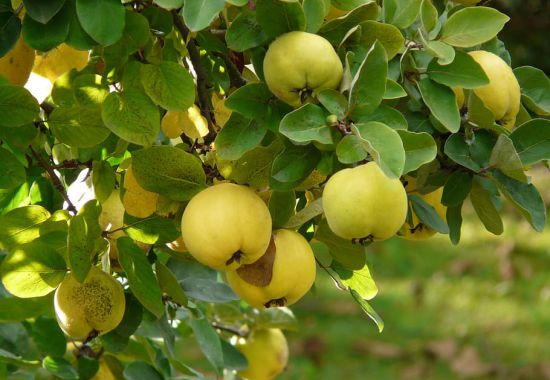
The quince tree is a small, spiny tree that can grow up to 6m in height with a shallow, shallow and shallow root system. Its branches are reddish / brown in color and tortuous, although quite flexible. Its leaves are alternate and whole, 5-10cm long with an oval blade. Its underside is whitish and hairy. Its flowers are hermaphroditic and large, with 5 white or slightly pink petals. It is a self-fertile plant. Its fruits have a maliform or piriform shape of variable size depending on the variety, with a yellow color and a stormy epidermis.
In Spain, the quince crop is very scarce, and is mainly concentrated in Andalusia and the Valencian Community. The total area in Spain is about 1,300 hectares, with an approximate production of 9,300 tons. Worldwide, the main quince producers are located in Turkey, China and Uzbekistan.
Soil
It prefers moderately fertile soils, not very limestone and ideally neutral or slightly acidic. Although it is considered a rustic plant, it needs not to lack moisture during the summer. It adapts well to heavy soils, it is a plant that tolerates root suffocation thanks to its superficial root system.
PH
Salinity
Quality
Temperature
The quince is a tree that adapts very well to intense cold (down to -25ºC in winter) and strong temperatures in summer. As its flowering is late, it presents few problems with frost. Its cold needs are low (100-500h), although it does need a lot of light to achieve optimal development of the plant and the fruit.
Irrigation
Irrigation properties
Varieties
The main varieties planted in Spain are from Portugal, Gigante de Wranja and Champion.