Description
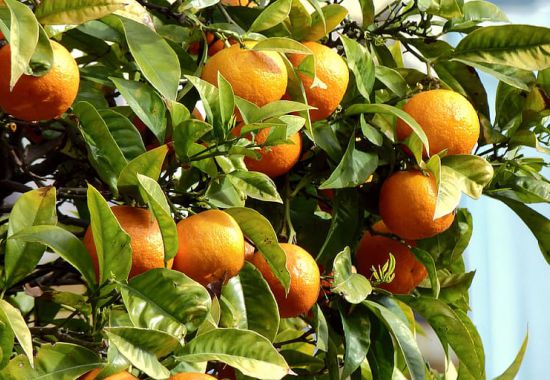
Orange trees are trees with a conical or globose crown that can reach up to 15 meters, although they are usually pruned at 5 meters to facilitate harvesting. Its trunk is short, smooth and greyish in color and its leaves are evergreen, oval and with a slightly winged petiole. The orange blossom is hermaphrodite, white in color and 5 petals. It can appear in clusters or solitary, and has a characteristic aroma. Its fruit is an orange-skinned band, with an orange or red pulp color, depending on the variety.
In Spain a total of 3,900,000 million tons of oranges are produced per year, grown on about 140,000 hectares. The main crop is the Navel Group, with some 100,000 cultivated hectares and a production of about 2,800,000 million tons per year.
Soil
Orange trees prefer a soil with a light texture, with good drainage and no stagnation problems. Good production is achieved at acid ranges of 5.5 to 6.5 pH, but the tree is able to tolerate pH ranging from 5 to 8. The crop is sensitive to salinity, so it must be controlled to avoid production losses.
PH
Salinity
Quality
Temperature
The orange tree is a tree that is sensitive to cold, so it should be grown in mild and warm climates, especially in the Mediterranean area of Tierras del Ebro and Valencia. Temperatures below 0ºC and for a long time can be dangerous for the tree, as well as cold and strong winds.
Irrigation
Irrigation properties
Varieties
In Spain, the most widely used cultivars are Navelina, Navel and Navelate from the Navel family; the Salustianas and the late oranges the Verna and Valencia late.
Other similar crops